| Characteristic |
English
|
Spanish
|
||
|---|---|---|---|---|
| G1 N = 1,019 |
G2 N = 1,062 |
G1 N = 779 |
G2 N = 670 |
|
| Timepoint | ||||
| Winter 2024 | 607 (88%) | 648 (89%) | 0 (NA%) | 436 (100%) |
| Fall 2024 | 81 (12%) | 78 (11%) | 0 (NA%) | 0 (0%) |
| Unknown | 331 | 336 | 779 | 234 |
| Administration Format | ||||
| CAT | 412 (40%) | 414 (39%) | 202 (26%) | 234 (35%) |
| Forms | 607 (60%) | 648 (61%) | 577 (74%) | 436 (65%) |
| Race | ||||
| American/Alaskan Native | 20 (2.0%) | 11 (1.1%) | 4 (2.0%) | 8 (1.2%) |
| Asian | 124 (12%) | 114 (11%) | 6 (3.0%) | 7 (1.1%) |
| Black/African American | 110 (11%) | 143 (14%) | 4 (2.0%) | 7 (1.1%) |
| Not reported | 195 (19%) | 223 (21%) | 79 (40%) | 381 (57%) |
| Other | 134 (13%) | 95 (9.2%) | 10 (5.0%) | 31 (4.7%) |
| White | 429 (42%) | 452 (44%) | 97 (49%) | 232 (35%) |
| Unknown | 7 | 24 | 579 | 4 |
| Ethnicity | ||||
| Hispanic/Latin(o/a) | 527 (52%) | 575 (55%) | 183 (91%) | 597 (91%) |
| Intentional nonreport | 7 (0.7%) | 4 (0.4%) | 0 (0%) | 4 (0.6%) |
| Not Hispanic/Latin(o/a) | 480 (47%) | 469 (45%) | 19 (9.4%) | 56 (8.5%) |
| Unknown | 5 | 14 | 577 | 13 |
| Gender | ||||
| Female | 487 (48%) | 522 (50%) | 109 (54%) | 374 (56%) |
| Male | 531 (52%) | 527 (50%) | 93 (46%) | 295 (44%) |
| Non-binary | 0 (0%) | 0 (0%) | 0 (0%) | 1 (0.1%) |
| Unknown | 1 | 13 | 577 | 0 |
| Home Language | ||||
| English | 738 (75%) | 715 (72%) | 44 (22%) | 103 (16%) |
| Spanish | 154 (16%) | 164 (17%) | 154 (77%) | 547 (83%) |
| Other | 97 (9.8%) | 112 (11%) | 2 (1.0%) | 7 (1.1%) |
| Unknown | 30 | 71 | 579 | 13 |
| English Proficiency Label | ||||
| (Re-)Classified Proficient | 80 (8.4%) | 82 (8.3%) | 33 (17%) | 99 (16%) |
| English Learner | 183 (19%) | 188 (19%) | 131 (66%) | 441 (70%) |
| English-only | 689 (72%) | 719 (73%) | 36 (18%) | 94 (15%) |
| Unknown | 67 | 73 | 579 | 36 |
| Ever IEP/504 | 81 (9.7%) | 83 (12%) | 18 (11%) | 49 (10%) |
| Unknown | 182 | 353 | 613 | 194 |
15 Nonword Reading
15.1 Task Description
Children are asked to read nonsense words that follow regular sound-spelling rules.
15.2 Construct
The Nonword Reading task measures the construct of decoding accuracy, the ability to translate print into speech by correctly pairing graphemes (letters) with their corresponding phonemes (sounds) using pronounceable nonsense words.
15.3 Item Development
15.3.1 English
The constructed items followed the English phonotactic structure, featuring diverse syllable constructions that reflect the language’s phonological patterns. Specific orthographic patterns that matched curriculum-based learning goals were targeted in the development of the items. Below, we provide the list of targets and the considerations for nonword development for each one of those targets.
- Predictable consonants: Nonwords with predictable consonants (i.e., m, s, t, l; p, f, c (/k/), n; b, r, j, k; v, g (/g/), w, d; h, y, z, x), and predictable short vowels.
- Consonant digraphs: Nonwords with consonant digraphs (i.e., ch, wh, th, ng) and predictable short vowels.
- Two-consonant blends: Nonwords with two-syllable blends (e.g., qu, st, sm, sn, -st, -ft, - lp; sr, sl, cr, cl, tr, dr) and predictable short vowels.
- Single consonants: Nonwords with single consonants (e.g., /s/ for c, s; /z/ for s, z; /k/ for k, c, -ck after a short vowel; /g/ for j, g)
- Hard and soft c and g: Nonwords with hard and soft c and g, with predictable short vowels, and VCe long vowel pattern in single-syllable words.
- Final consonant blends with nasals: Nonwords with final nasal consonant blends (i.e., nt, nd, mp, nk) with predictable short vowels.
- VCe long vowel pattern in single-syllable words: Nonwords with VCe long vowel pattern in single-syllable words, including also predictable consonants, consonant diagraphs, and/or two consonant blends.
- Vowel teams for long vowel sounds: Nonwords with vowel teams for long vowel sounds (e.g., ee, ea; ai, ay; oa, ow, oe; igh), including also predictable consonants, consonant digraphs, and/or two consonant blends.
- Vowel-r combinations with single syllables: Nonwords with vowel-r combinations and single syllables (i.e., er, ar, or, ir, ur) with predictable short vowels.
- Other vowel-r combinations: Nonwords with other vowel-r combinations (e.g., are, air, our, ore, ear, eer, ure), including also predictable consonants.
- Diphthongs and vowels: Nonwords with diphthongs and vowels (e.g., /aw/ and /oo/: oi, oy; ou, ow; au, aw; oo, u), including also predictable consonants, consonant digraphs, and/or two consonant blends.
- Use of y: Nonwords with y as consonant /y/, as /ı/ on ends of one-syllable words like fly, as /e/ on ends of multisyllabic words like lobby, or as /ı/ in a few words like myth.
- Use of -ild, -ost, -old, -olt, -ind pattern: Nonwords with -ild, -ost, -old, -olt, -ind, including also predictable consonants and/or consonant digraphs.
- Digraphs: Nonwords with figraphs (e.g., ph (/f/), gh (/f/), ch (/k/ and /sh/))
- Trigraphs: Nonwords with trigraphs (e.g., -tch (/ch/), -dge (/j/)).
- Three-consonant blends and blends with digraphs: Nonwords with three-consonant blends and blends with digraphs (e.g., squ, str, scr, thr, shr) and predictable short vowels.
15.3.2 Spanish
The constructed items followed the Spanish phonotactic structure, featuring diverse syllable constructions that reflect the language’s phonological patterns. The length of the items ranged from succinct two-phoneme combinations to more intricate six-phoneme combinations. While two-phoneme words are relatively uncommon in the Spanish lexicon, we deliberately incorporated two-phoneme nonwords into our dataset to include easier items. Below, we provide the list of targets and the considerations for nonword development for each one of those targets.
- Predictable consonants: Nonwords with predictable consonants (i.e., m, s, t, l; p, f, n; b, r, j, v, d, y, z).
- Consonant digraphs: Nonwords with consonant digraphs (i.e., ch, ll, rr).
- Two-consonant blends: Nonwords with two-syllable blends (e.g., br, bl, cr, cl, tr, dr).
- Single consonants: Nonwords with single consonants (e.g., /s/ for c, z; /g/ for j, g)
- Hard and soft c and g: Nonwords with hard and soft c and g.
- Diphthongs and vowels: Nonwords with diphthongs and vowels (e.g., /ai/, /ei/), including also predictable consonants, consonant digraphs, and/or two consonant blends.
- Hiatus: sequence of vowels belonging to different syllables (e.g., /ia/, /ua/).
- Stress types: words that with antepenultimate stress, penultimate stress, and ultimate stress.
15.4 Scoring
Dichotomous fixed response format of 0 points for incorrect responses or non-responses and 1 point for correct ones.
15.5 Calibration Samples
15.6 Psychometric Analysis
15.6.1 Basic Item Statistics
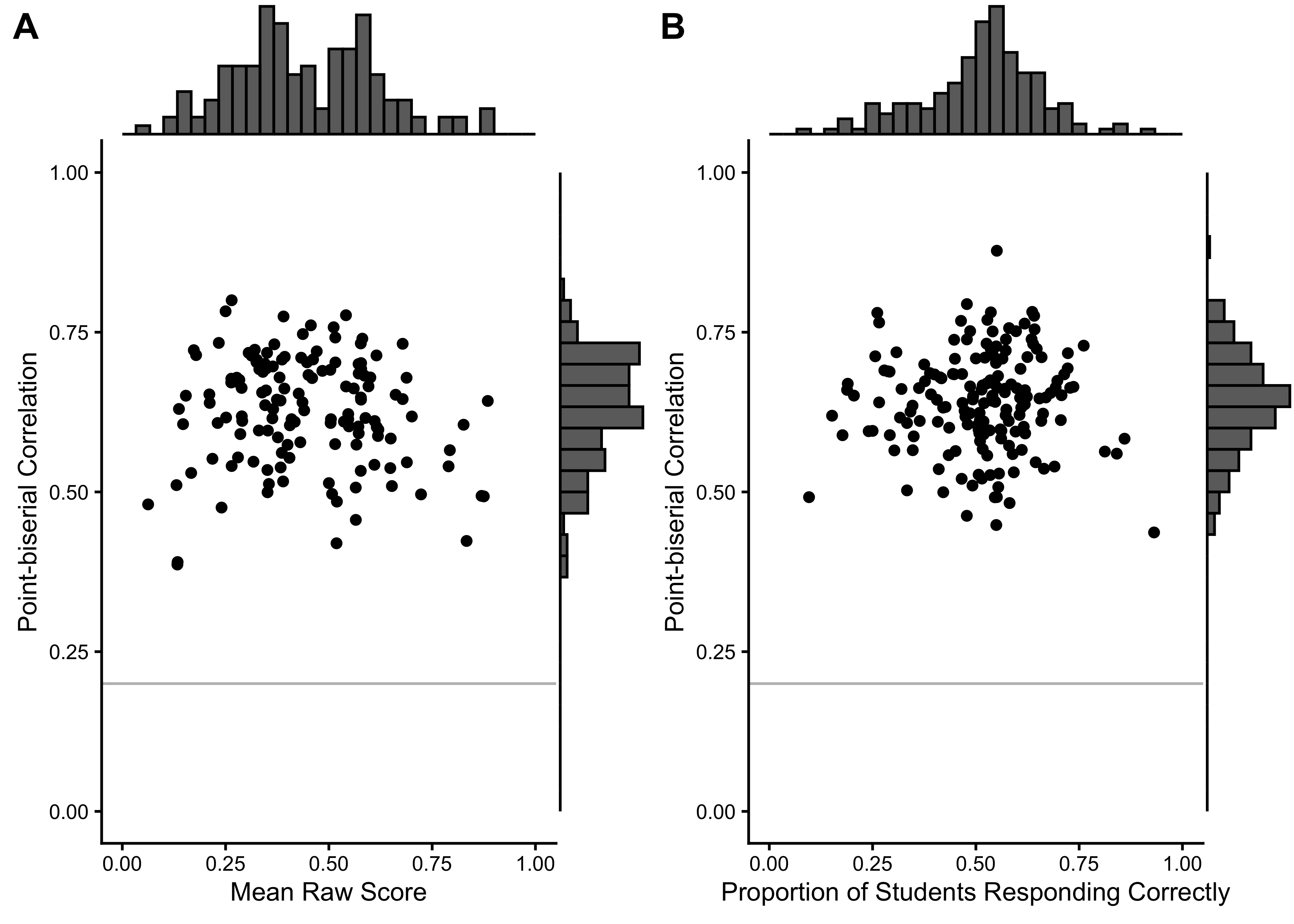
We excluded 16 items from the English task and 0 items from the Spanish task based on low response counts (n < 90). 0 items were excluded because they had no variance in the Spanish task, and 1 items in the English task. Additionally, we excluded 0 items from the English task and 0 items from the Spanish task based on low point-biserial correlations (r < 0.2). Table 15.2 summarizes the basic item characteristics, Figure 15.1 shows the relationship between point-biserial correlations and the proportion of correct responses for each item.
English
|
Spanish
|
|||
|---|---|---|---|---|
| Characteristic |
Before Excl.
|
After Excl.
|
Before Excl.
|
After Excl.
|
| N = 143 | N = 127 | N = 170 | N = 170 | |
| No. of Responses | 211 (141) | 234 (132) | 231 (148) | 231 (148) |
| Proportion Correct | 0.44 (0.18) | 0.44 (0.16) | 0.51 (0.14) | 0.51 (0.14) |
| Point-biserial Correlation | 0.63 (0.08) | 0.63 (0.08) | 0.64 (0.08) | 0.64 (0.08) |
| Excluded (n < 90) | 16 (11%) | 0 (0%) | 0 (0%) | 0 (0%) |
| Excluded (pbis < .2) | 0 (0%) | 0 (0%) | 0 (0%) | 0 (0%) |
| Excluded (no variation) | 1 (0.7%) | 0 (0%) | 0 (0%) | 0 (0%) |
15.6.2 Rasch Analysis
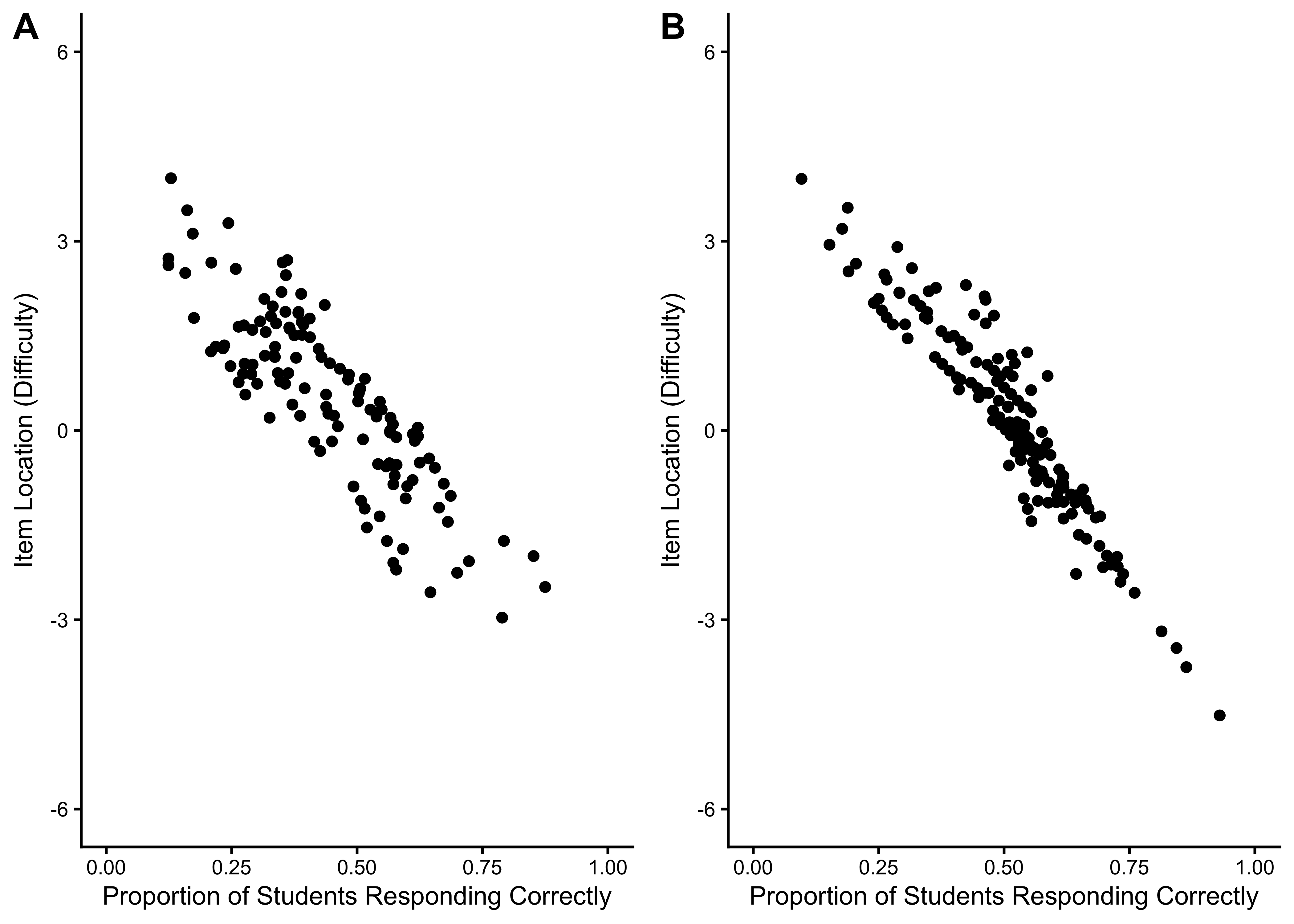
15.6.2.1 Item Location Estimates
15.6.2.2 Item Fit Statistics
| A | B | C | D | Total | A | B | C | D | Total | |
|---|---|---|---|---|---|---|---|---|---|---|
| Outfit MSE | ||||||||||
| A | 112 | 0 | 0 | 0 | 112 | 153 | 0 | 0 | 0 | 153 |
| B | 5 | 0 | 0 | 0 | 5 | 4 | 0 | 0 | 0 | 4 |
| C | 7 | 0 | 0 | 0 | 7 | 9 | 0 | 0 | 0 | 9 |
| D | 3 | 0 | 0 | 0 | 3 | 4 | 0 | 0 | 0 | 4 |
| Total | 127 | 0 | 0 | 0 | 127 | 170 | 0 | 0 | 0 | 170 |
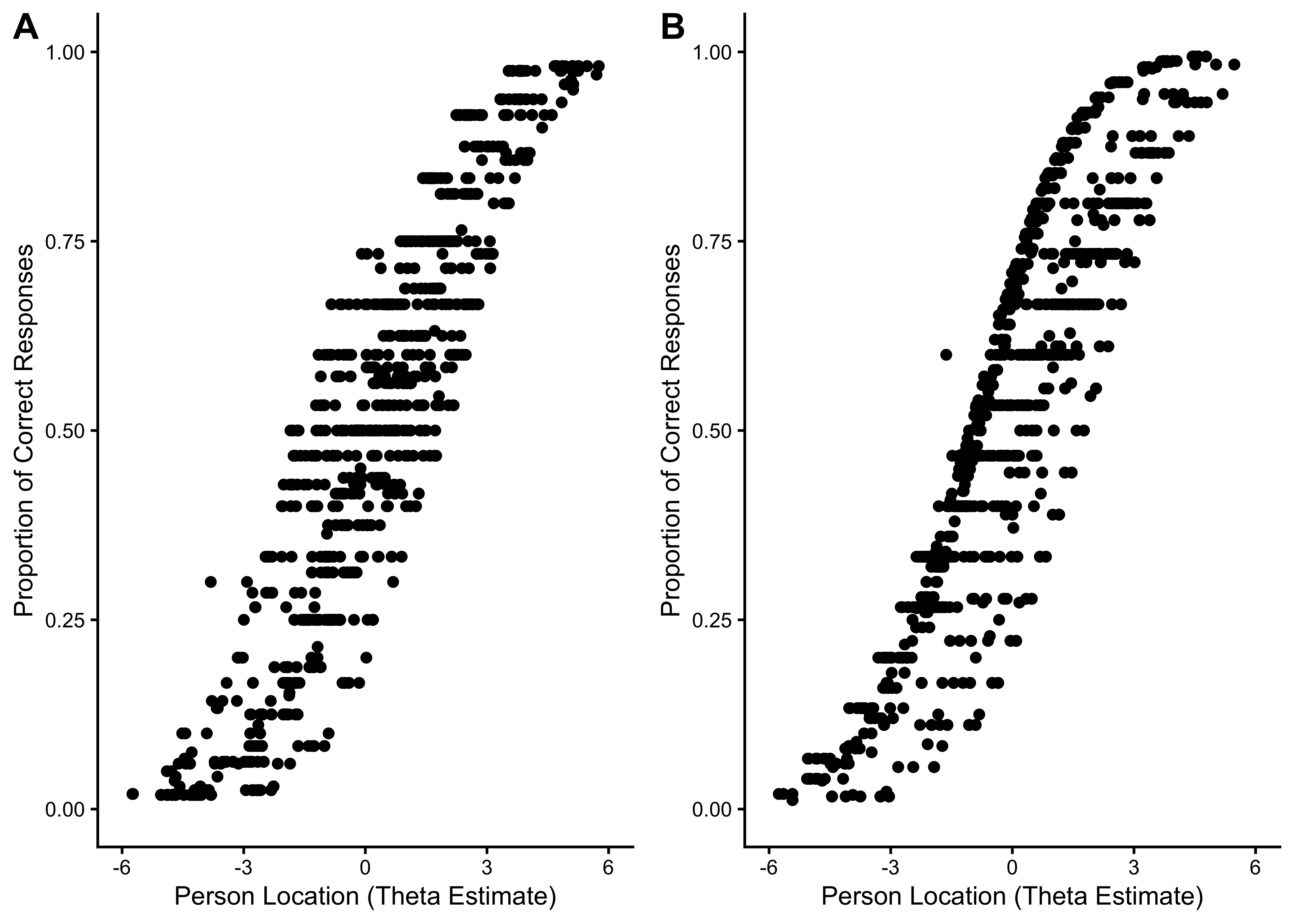
15.6.2.3 Person Location Estimates
15.6.2.4 Person Fit Statistics
| A | B | C | D | Total | A | B | C | D | Total | |
|---|---|---|---|---|---|---|---|---|---|---|
| Outfit MSE | ||||||||||
| A | 1,204 | 0 | 4 | 0 | 1,208 | 1,028 | 0 | 1 | 0 | 1,029 |
| B | 279 | 421 | 0 | 0 | 700 | 143 | 172 | 0 | 0 | 315 |
| C | 77 | 0 | 11 | 0 | 88 | 43 | 0 | 5 | 0 | 48 |
| D | 43 | 0 | 18 | 2 | 63 | 33 | 0 | 9 | 0 | 42 |
| Total | 1,603 | 421 | 33 | 2 | 2,059 | 1,247 | 172 | 15 | 0 | 1,434 |
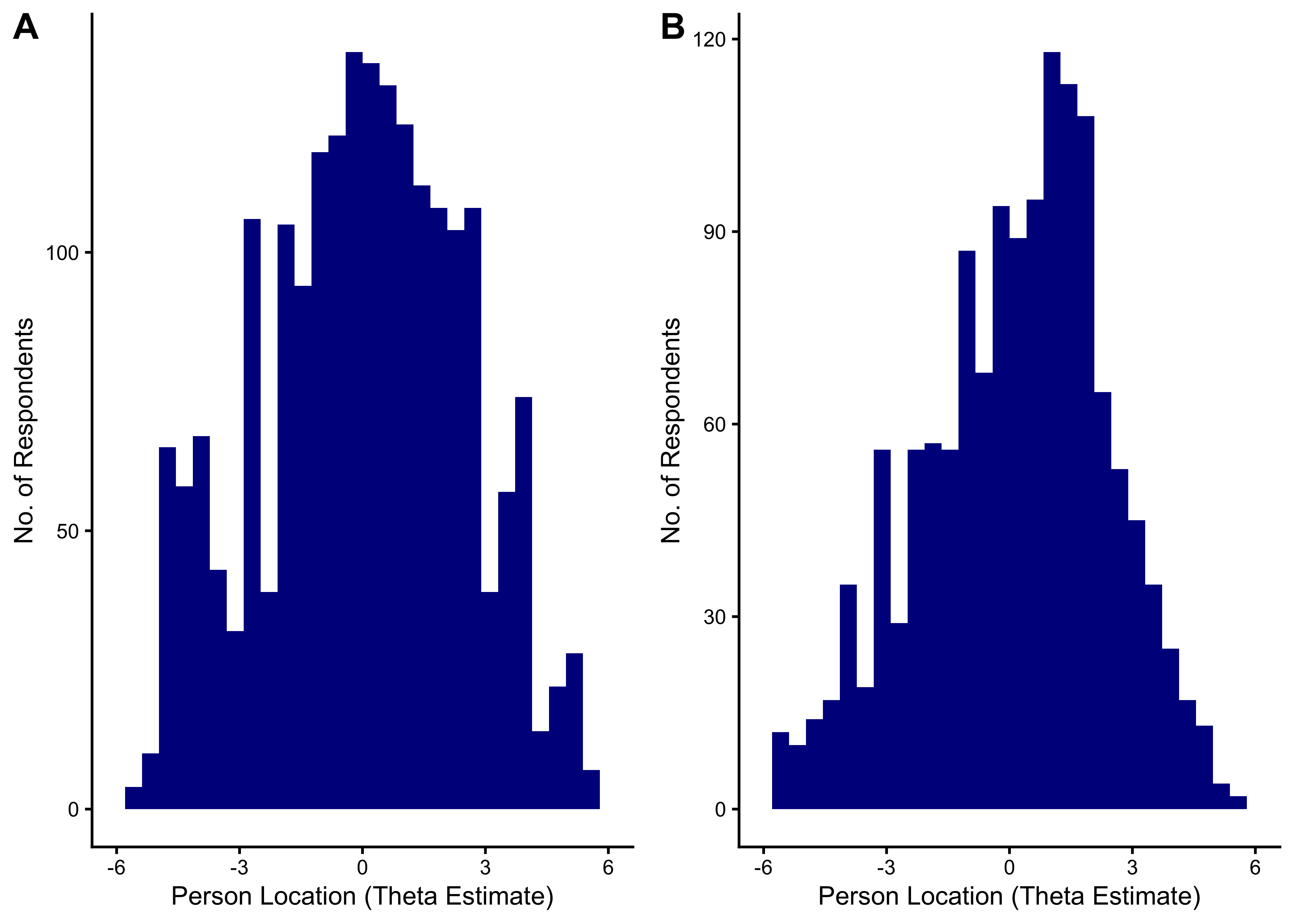
15.6.2.5 Distribution of Theta Estimates
15.6.2.6 Wright Maps
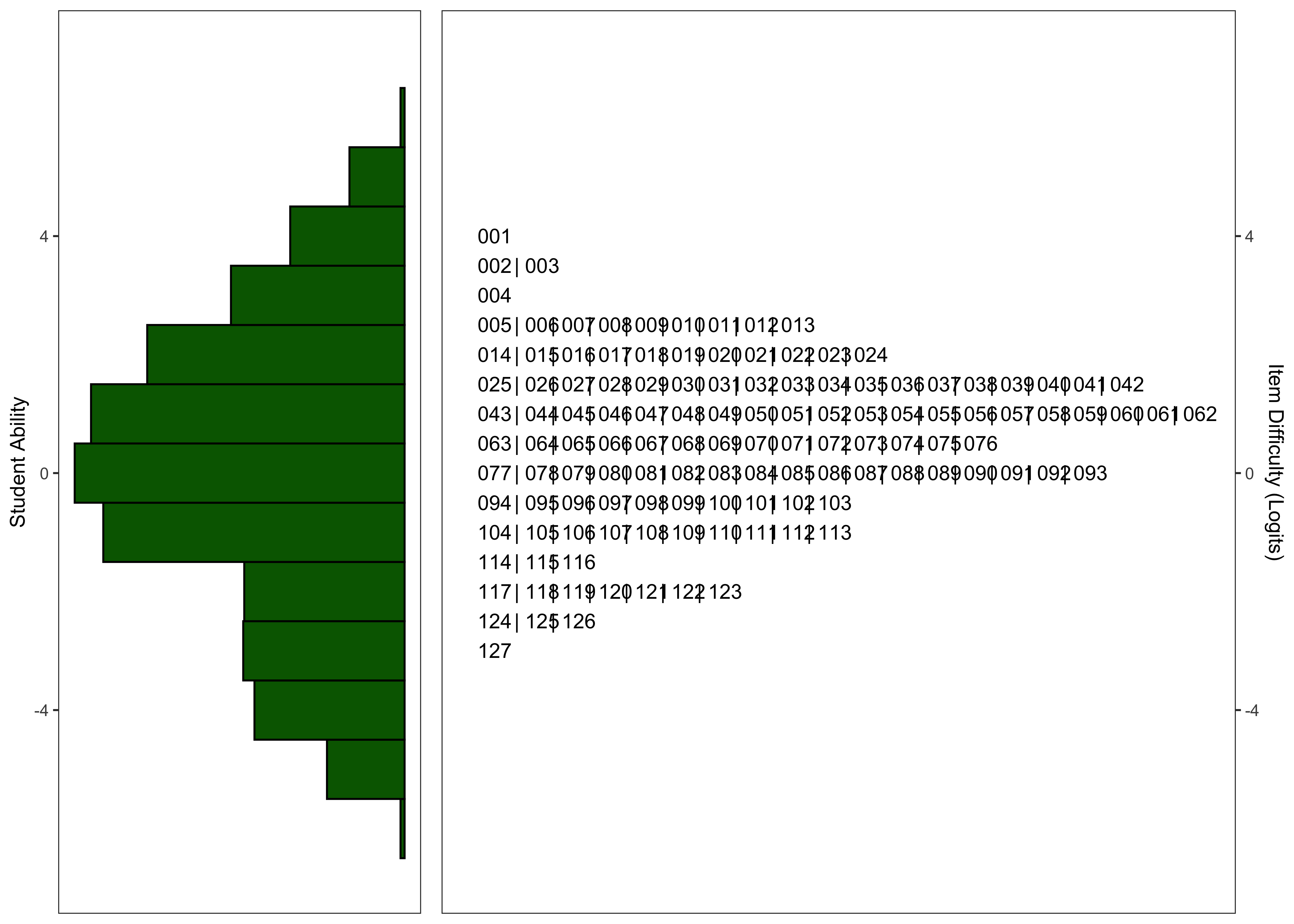
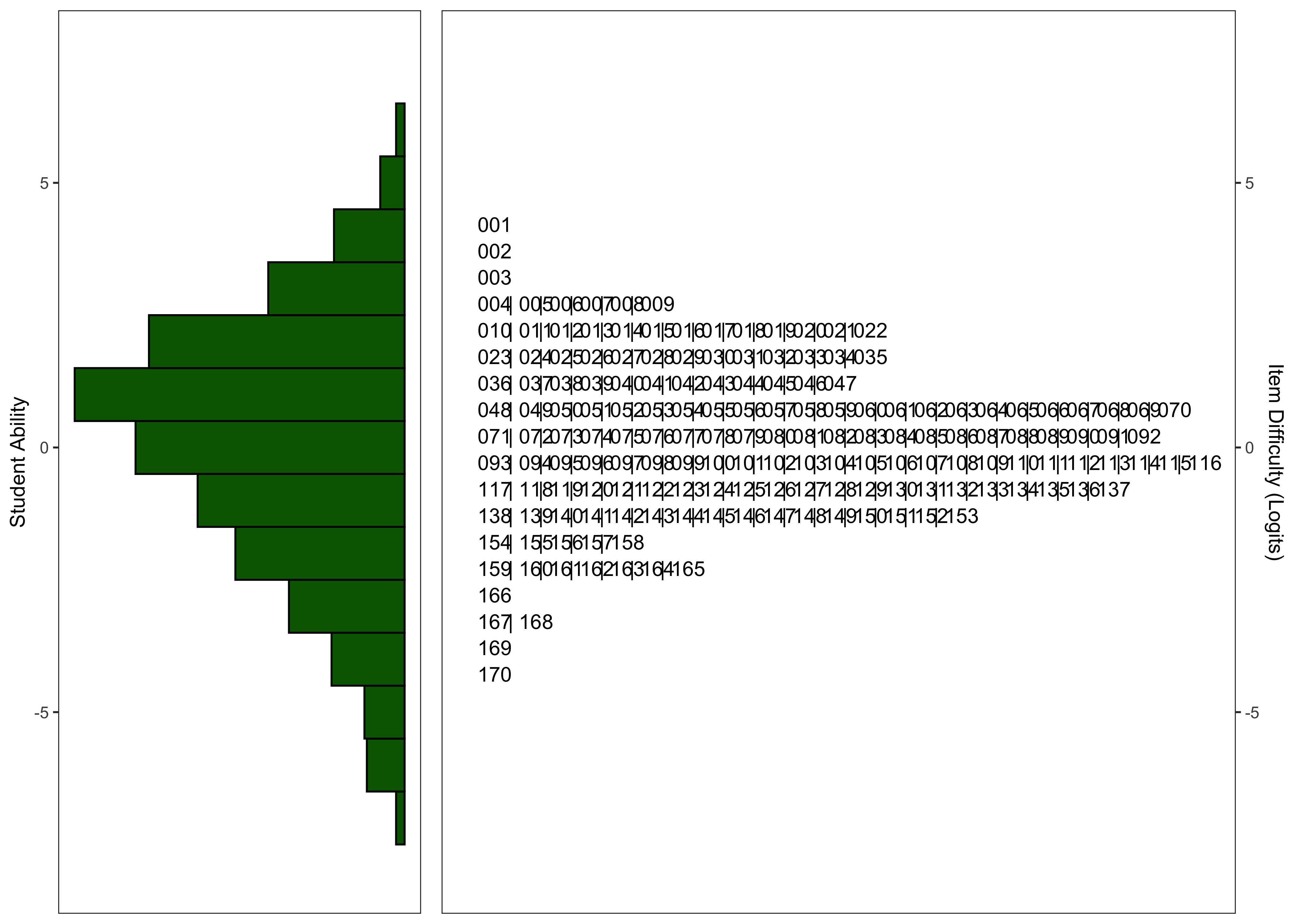
15.6.2.7 Model Summary
| Characteristic | N = 127 | N = 2,059 | N = 170 | N = 1,434 |
|---|---|---|---|---|
| Logit Scale Location | 0.55 (1.42) | 0.05 (-1.69, 1.83) | 0.16 (1.46) | 0.34 (-1.53, 1.76) |
| Outfit | 0.99 (0.40) | 0.66 (0.35, 0.93) | 0.96 (0.35) | 0.80 (0.55, 0.96) |
| Infit | 0.99 (0.12) | 0.82 (0.58, 1.00) | 0.98 (0.12) | 0.88 (0.75, 0.99) |
| Reliability of Separation | 0.8891 | 0.8279 | 0.9269 | 0.8892 |
15.6.2.7.1 Final Number of Items
Following the exclusion of items with point-biserial correlations < .20 and items with poor fit statistics, the final versions of the task contain 127 and 170 for the English and Spanish task, respectively.
15.7 Criterion Validity Evidence
15.7.1 Sample
| Characteristic |
English
|
Spanish
|
|||
|---|---|---|---|---|---|
| K N = 79 |
G1 N = 223 |
G2 N = 258 |
G1 N = 194 |
G2 N = 229 |
|
| Timepoint | |||||
| Spring 2024 | 0 (0%) | 223 (100%) | 258 (100%) | 194 (100%) | 229 (100%) |
| Spring 2025 | 79 (100%) | 0 (0%) | 0 (0%) | ||
| Race | |||||
| American/Alaskan Native | 4 (5.5%) | 5 (2.2%) | 1 (0.4%) | 4 (2.1%) | 4 (1.8%) |
| Asian | 5 (6.8%) | 25 (11%) | 33 (13%) | 6 (3.1%) | 3 (1.3%) |
| Black/African American | 4 (5.5%) | 27 (12%) | 32 (12%) | 4 (2.1%) | 4 (1.8%) |
| Not reported | 13 (18%) | 55 (25%) | 68 (26%) | 75 (39%) | 97 (43%) |
| Other | 22 (30%) | 35 (16%) | 26 (10%) | 10 (5.2%) | 15 (6.6%) |
| White | 25 (34%) | 76 (34%) | 98 (38%) | 93 (48%) | 104 (46%) |
| Unknown | 6 | 0 | 0 | 2 | 2 |
| Ethnicity | |||||
| Hispanic/Latin(o/a) | 49 (84%) | 102 (46%) | 140 (54%) | 175 (90%) | 201 (88%) |
| Intentional nonreport | 0 (0%) | 2 (0.9%) | 0 (0%) | 0 (0%) | 2 (0.9%) |
| Not Hispanic/Latin(o/a) | 9 (16%) | 119 (53%) | 118 (46%) | 19 (9.8%) | 26 (11%) |
| Unknown | 21 | 0 | 0 | ||
| Gender | |||||
| Female | 36 (46%) | 98 (44%) | 126 (49%) | 103 (53%) | 129 (56%) |
| Male | 43 (54%) | 125 (56%) | 132 (51%) | 91 (47%) | 100 (44%) |
| Home Language | |||||
| English | 27 (53%) | 161 (73%) | 177 (69%) | 44 (23%) | 57 (25%) |
| Spanish | 23 (45%) | 37 (17%) | 41 (16%) | 146 (76%) | 166 (74%) |
| Other | 1 (2.0%) | 23 (10%) | 39 (15%) | 2 (1.0%) | 1 (0.4%) |
| Unknown | 28 | 2 | 1 | 2 | 5 |
| English Proficiency Label | |||||
| (Re-)Classified Proficient | 1 (3.3%) | 22 (10%) | 23 (9.0%) | 33 (17%) | 37 (17%) |
| English Learner | 21 (70%) | 47 (22%) | 59 (23%) | 123 (64%) | 131 (59%) |
| English-only | 8 (27%) | 148 (68%) | 173 (68%) | 36 (19%) | 54 (24%) |
| Unknown | 49 | 6 | 3 | 2 | 7 |
| Ever IEP/504 | 7 (23%) | 22 (11%) | 29 (14%) | 16 (10%) | 17 (9.2%) |
| Unknown | 49 | 24 | 47 | 36 | 45 |
English Nonword Reading was correlated with the Word Attack subtest from the Woodcock-Johnson IV (WJ IV ACH) test (Schrank, McGrew, and Mather 2014). Spanish Nonword Reading was correlated with the Análisis de palabras subtest from the Batería IV Woodcock-Muñoz (Batería IV APROV) test (Woodcock et al. 2019).
| Grade | n | r [CI] | n | r [CI] | n | r [CI] |
|---|---|---|---|---|---|---|
| G1 | 222 | 0.75 [0.69, 0.80] | 47 | 0.77 [0.62, 0.86] | 194 | 0.82 [0.77, 0.87] |
| G2 | 258 | 0.71 [0.65, 0.77] | 59 | 0.77 [0.64, 0.86] | 229 | 0.75 [0.69, 0.81] |