| Characteristic |
English
|
Spanish
|
||||
|---|---|---|---|---|---|---|
| K N = 2,751 |
G1 N = 3,104 |
G2 N = 798 |
K N = 1,202 |
G1 N = 1,192 |
G2 N = 376 |
|
| Timepoint | ||||||
| Fall 2023 | 461 (18%) | 396 (14%) | 418 (79%) | 438 (44%) | 388 (41%) | 370 (99%) |
| Fall 2024 | 2,054 (82%) | 2,381 (86%) | 113 (21%) | 568 (56%) | 560 (59%) | 3 (0.8%) |
| Unknown | 236 | 327 | 267 | 196 | 244 | 3 |
| Administration Format | ||||||
| Not applicable | 2,751 (100%) | 3,104 (100%) | 798 (100%) | 1,202 (100%) | 1,192 (100%) | 376 (100%) |
| Race | ||||||
| American/Alaskan Native | 90 (3.6%) | 108 (3.8%) | 3 (0.4%) | 39 (3.4%) | 41 (3.5%) | 2 (0.5%) |
| Asian | 181 (7.3%) | 222 (7.9%) | 83 (11%) | 47 (4.1%) | 38 (3.2%) | 6 (1.6%) |
| Black/African American | 236 (9.5%) | 280 (9.9%) | 84 (11%) | 12 (1.1%) | 17 (1.5%) | 3 (0.8%) |
| Not reported | 295 (12%) | 347 (12%) | 179 (23%) | 422 (37%) | 475 (41%) | 218 (58%) |
| Other | 549 (22%) | 418 (15%) | 92 (12%) | 258 (23%) | 114 (9.7%) | 12 (3.2%) |
| White | 1,139 (46%) | 1,441 (51%) | 323 (42%) | 361 (32%) | 485 (41%) | 134 (36%) |
| Unknown | 261 | 288 | 34 | 63 | 22 | 1 |
| Ethnicity | ||||||
| Hispanic/Latin(o/a) | 1,605 (70%) | 1,948 (69%) | 377 (50%) | 1,001 (95%) | 1,100 (95%) | 345 (92%) |
| Intentional nonreport | 32 (1.4%) | 12 (0.4%) | 3 (0.4%) | 5 (0.5%) | 1 (<0.1%) | 0 (0%) |
| Not Hispanic/Latin(o/a) | 669 (29%) | 862 (31%) | 374 (50%) | 49 (4.6%) | 59 (5.1%) | 31 (8.2%) |
| Unknown | 445 | 282 | 44 | 147 | 32 | 0 |
| Gender | ||||||
| Female | 1,158 (50%) | 1,408 (50%) | 360 (47%) | 557 (53%) | 608 (54%) | 195 (52%) |
| Male | 1,170 (50%) | 1,395 (50%) | 403 (53%) | 496 (47%) | 527 (46%) | 181 (48%) |
| Unknown | 423 | 301 | 35 | 149 | 57 | 0 |
| Home Language | ||||||
| English | 1,531 (66%) | 1,655 (65%) | 560 (74%) | 167 (15%) | 144 (12%) | 48 (13%) |
| Spanish | 702 (30%) | 834 (33%) | 115 (15%) | 956 (85%) | 1,018 (87%) | 315 (85%) |
| Other | 93 (4.0%) | 75 (2.9%) | 81 (11%) | 6 (0.5%) | 4 (0.3%) | 6 (1.6%) |
| Unknown | 425 | 540 | 42 | 73 | 26 | 7 |
| English Proficiency Label | ||||||
| (Re-)Classified Proficient | 87 (4.1%) | 139 (5.6%) | 61 (8.1%) | 94 (9.3%) | 138 (12%) | 54 (15%) |
| English Learner | 647 (30%) | 758 (31%) | 136 (18%) | 803 (79%) | 861 (77%) | 270 (74%) |
| English-only | 1,394 (66%) | 1,569 (64%) | 559 (74%) | 115 (11%) | 122 (11%) | 42 (11%) |
| Unknown | 623 | 638 | 42 | 190 | 71 | 10 |
| Ever IEP/504 | 154 (8.2%) | 203 (9.4%) | 77 (13%) | 79 (8.5%) | 93 (9.3%) | 33 (12%) |
| Unknown | 882 | 938 | 227 | 270 | 187 | 109 |
20 Rapid Automatized Naming of Objects
20.1 Task Description
Children are shown a page with 5 unique objects repeated randomly, arranged in five rows of ten. They are asked to name as many objects as quickly as possible.
20.2 Construct
The Rapid Automatized Naming - Objects task measures the construct of automaticity in processing and retrieval of object names. It assesses how quickly and accurately children can name familiar objects, skills that are closely linked to automatic reading.
20.3 Item Development
Target concepts were selected to be appropriate for both English and Spanish speakers in their respective languages. The selection process involved identifying words acquired early in development, characterized by brevity (one or two syllables) in both languages. These words were chosen based on their likely familiarity to students, irrespective of their backgrounds. Additional consideration was given to selecting words from diverse semantic categories, while avoiding phonemes or phonemic clusters known for difficulty in pronunciation in both languages. Additional information about the selected words and their semantic categories, length, frequency, and age of acquisition was also taken into consideration. The five items selected for the English ad Spanish subtest were hand, chair, cheese, moon, and cat.
It is important to note that student performance for completing this task in English and Spanish is not directly comparable. This is due to the rarity of highly imaginable monosyllabic nouns in Spanish. Consequently, while the majority of items in English are monosyllabic –thus, faster to pronounce–, their Spanish counterparts are often disyllabic and phonetically longer, making their labeling slower.
20.4 Scoring
Participating children were presented with a 5x10 grid containing 50 illustrations of the selected objects and were asked to name as fast as they could, and the time taken by the participant to name all objects was recorded. The final score consisted of a rate between the number of accurately named objects (i.e., the total number of objects minus the incorrectly named objects) divided by the total time it took the child to complete namig all items in the grid.
20.5 Samples
20.6 Score distribution
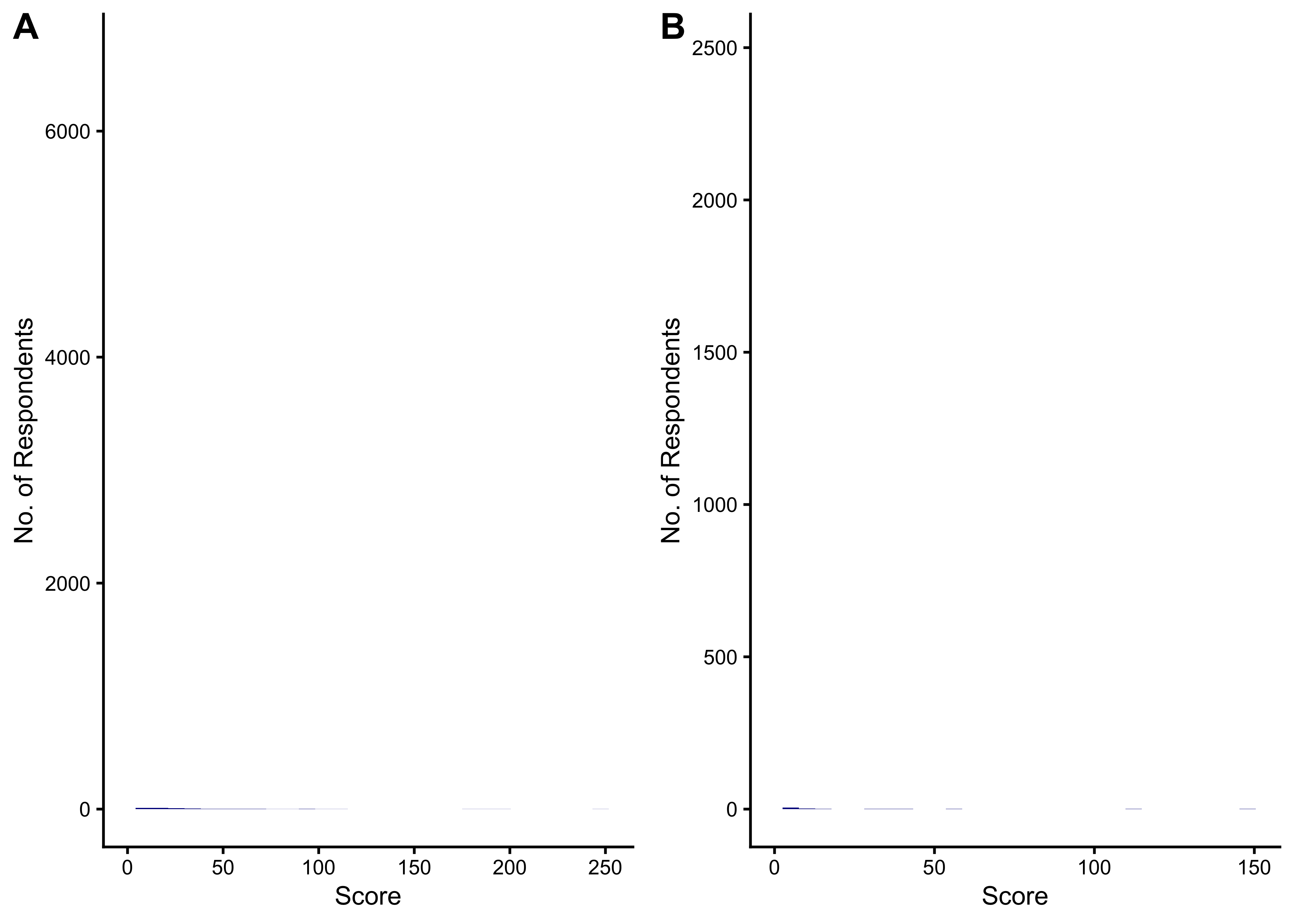
20.7 Criterion Validity Evidence
20.7.1 Sample
| Characteristic |
English
|
Spanish
|
||
|---|---|---|---|---|
| K N = 209 |
G1 N = 227 |
K N = 163 |
G1 N = 214 |
|
| Timepoint | ||||
| Spring 2024 | 209 (100%) | 227 (100%) | 163 (100%) | 214 (100%) |
| Race | ||||
| American/Alaskan Native | 2 (1.0%) | 4 (1.8%) | 5 (3.1%) | 3 (1.4%) |
| Asian | 29 (14%) | 30 (13%) | 9 (5.5%) | 5 (2.4%) |
| Black/African American | 23 (11%) | 26 (11%) | 1 (0.6%) | 2 (0.9%) |
| Not reported | 38 (18%) | 56 (25%) | 64 (39%) | 100 (47%) |
| Other | 50 (24%) | 30 (13%) | 29 (18%) | 8 (3.8%) |
| White | 67 (32%) | 81 (36%) | 55 (34%) | 94 (44%) |
| Ethnicity | ||||
| Hispanic/Latin(o/a) | 99 (47%) | 97 (43%) | 151 (93%) | 199 (93%) |
| Intentional nonreport | 10 (4.8%) | 2 (0.9%) | 1 (0.6%) | 0 (0%) |
| Not Hispanic/Latin(o/a) | 100 (48%) | 128 (56%) | 11 (6.7%) | 15 (7.0%) |
| Gender | ||||
| Female | 111 (53%) | 108 (48%) | 95 (58%) | 117 (55%) |
| Male | 98 (47%) | 119 (52%) | 68 (42%) | 97 (45%) |
| Home Language | ||||
| English | 151 (73%) | 165 (73%) | 28 (17%) | 30 (14%) |
| Spanish | 39 (19%) | 32 (14%) | 135 (83%) | 180 (85%) |
| Other | 18 (8.7%) | 28 (12%) | 0 (0%) | 2 (0.9%) |
| Unknown | 1 | 2 | 0 | 2 |
| English Proficiency Label | ||||
| (Re-)Classified Proficient | 17 (9.2%) | 26 (12%) | 23 (15%) | 37 (18%) |
| English Learner | 38 (21%) | 45 (20%) | 114 (75%) | 149 (71%) |
| English-only | 129 (70%) | 152 (68%) | 15 (9.9%) | 24 (11%) |
| Unknown | 25 | 4 | 11 | 4 |
| Ever IEP/504 | 9 (5.9%) | 22 (11%) | 8 (5.7%) | 17 (9.3%) |
| Unknown | 57 | 22 | 23 | 32 |
| Unknown | 0 | 2 | ||
English Rapid Automatized Naming of Objects was correlated with two measures: the Objects subtest from the Acadience Learning RAN (Powell-Smith et al. 2020) in kindergarten and first grade, and the RAN Objects subtest from the Rapid Automatized Naming and Rapid Alternating Stimulus Tests (Wolf and Denckla 2003) in second grade.
Spanish Rapid Automatized Naming of Objects was correlated with the Objects subtest from the Acadience Learning RAN (Powell-Smith et al. 2020) in kindergarten and first grade. No rapid naming of objects task could be found in Spanish that was normed on second-grade-aged children in the United States.
These analyses are problematic because of differences in how the measures are scored. The external assessments are scored based on total time, with RAN Objects and RAN Letters being completed in tandem. The Multitudes RANO measure is scored as the number correct divided by the total time and is distinct from RANL. Given these scoring differences, the correlations are difficult to interpret.
| Grade | n | r [CI] | n | r [CI] | n | r [CI] |
|---|---|---|---|---|---|---|
| K | 209 | -0.50 [-0.60, -0.39] | 38 | -0.37 [-0.62, -0.06] | 163 | -0.58 [-0.67, -0.47] |
| G1 | 225 | -0.57 [-0.65, -0.47] | 45 | -0.67 [-0.81, -0.47] | 214 | -0.61 [-0.69, -0.52] |